

The Gambler’s Fallacy: Why Past Lottery Results Don’t Predict the Future
Every lottery player has probably felt it at some point: the strong feeling that a specific number is "due" to win. Maybe you’ve been tracking a TOTO number that hasn't appeared in months, or you’ve noticed a specific 4D combination that seems to be hiding. You think to yourself, "It hasn't come out in so long, it has to be drawn today!"
This line of thinking is incredibly common, but it is also a well-known psychological trap called the Gambler's Fallacy. If you want to play Singapore 4D or TOTO smartly and responsibly, you need to understand why past results have zero impact on future draws.
What is the Gambler’s Fallacy?
The Gambler’s Fallacy is the mistaken belief that if an event happens more frequently than normal during a given period, it will happen less frequently in the future (or vice versa).
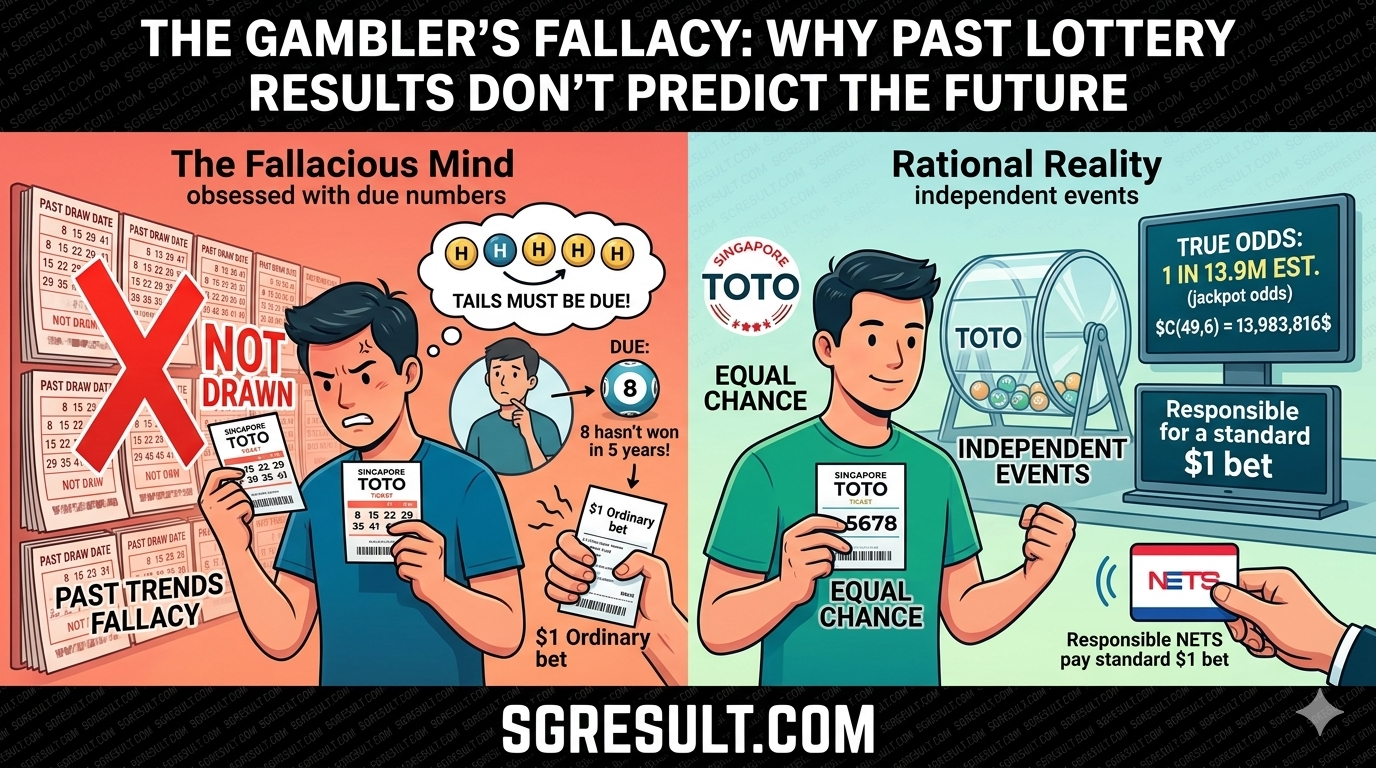
The classic example is a coin toss. Imagine you flip a fair coin, and it lands on 'Heads' five times in a row. A person suffering from the Gambler's Fallacy will strongly believe that the next flip must be 'Tails' to balance things out.
However, the coin has no memory. The odds of the sixth flip are exactly the same as the first: 50% Heads, 50% Tails.
How This Applies to Singapore 4D and TOTO
Lottery machines operate on the exact same principle as the coin toss. They generate independent events.
When the Singapore Pools machines draw the winning numbers for tonight’s TOTO or 4D, the balls (or digital generators) do not remember what happened yesterday, last week, or ten years ago. The machine does not know that the number "1234" hasn't won a prize since 2015.
Therefore, a number that hasn't appeared in 5 years has the exact same mathematical probability of being drawn tonight as a number that won the 1st Prize just yesterday. The past cannot and does not predict the future.
The Danger of Chasing "Due" Numbers
Believing in the Gambler's Fallacy can be dangerous for your wallet. It often leads to a betting behavior known as "chasing losses."
A player might continuously double their bet on a specific "cold" number, convinced that a win is mathematically guaranteed to happen soon. Because the lottery is entirely random, that number might not appear for another ten years. Understanding that no number is ever "due" helps you maintain a healthy budget and prevents you from making emotional betting decisions.
Why Do We Look at Historical Stats Then?
If past results don't predict the future, why do platforms offer detailed stats pages and historical data?
The answer is simple: Entertainment and Variance Tracking.
Human beings love recognizing patterns. Looking at past 4D results or analyzing TOTO trends is a fun way to engage with the game. It allows players to see statistical variance in action—observing which numbers are currently "hot" (appearing frequently due to short-term variance) and which are "cold."
Using stats to pick your numbers makes the game more interactive and enjoyable, as long as you understand that these numbers don't actually have a higher probability of winning. It is about playing a strategy for fun, rather than relying on it as a guaranteed financial investment.
Conclusion
The next time you buy a ticket, remember that every single draw is a fresh start. Whether you carefully select your numbers using historical data from our TOTO results archive, or you just buy a random Quick Pick, your odds are exactly the same.
Enjoy the thrill of the draw, check the latest winning numbers directly on our homepage, and most importantly—always play responsibly and within your means!