

The Science of Random Number Generators (RNG) in Modern Lotteries
For decades, the image of a lottery draw was synonymous with a plastic drum filled with numbered ping-pong balls bouncing wildly in the air. While physical draw machines are still used in many parts of the world, modern lotteries are increasingly turning to digital solutions to ensure absolute fairness and security.
At the heart of this digital transformation is the Random Number Generator (RNG). But how exactly does a computer—a machine built on strict logic and predictable codes—generate something entirely random? Let’s dive into the fascinating science behind RNG in modern lotteries.
True Randomness vs. Pseudo-Randomness
To understand lottery RNGs, we first need to understand that there are two main types of random number generators:
Pseudo-Random Number Generators (PRNGs): These are algorithms used in basic computer programming and video games. They use a mathematical formula and a "seed" number to produce a sequence of numbers that looks random. However, because it relies on a set formula, if someone knew the exact algorithm and the seed, they could predict the next number. Therefore, PRNGs are never used for high-stakes lotteries.
Hardware or True Random Number Generators (HRNG/TRNG): This is the gold standard used by modern state lotteries. Instead of relying on math formulas, TRNGs extract randomness from physical, unpredictable phenomena in the real world.
How True RNGs Extract Chaos from the Universe
A computer cannot be naturally random on its own, so a True RNG connects the computer to the physical universe.
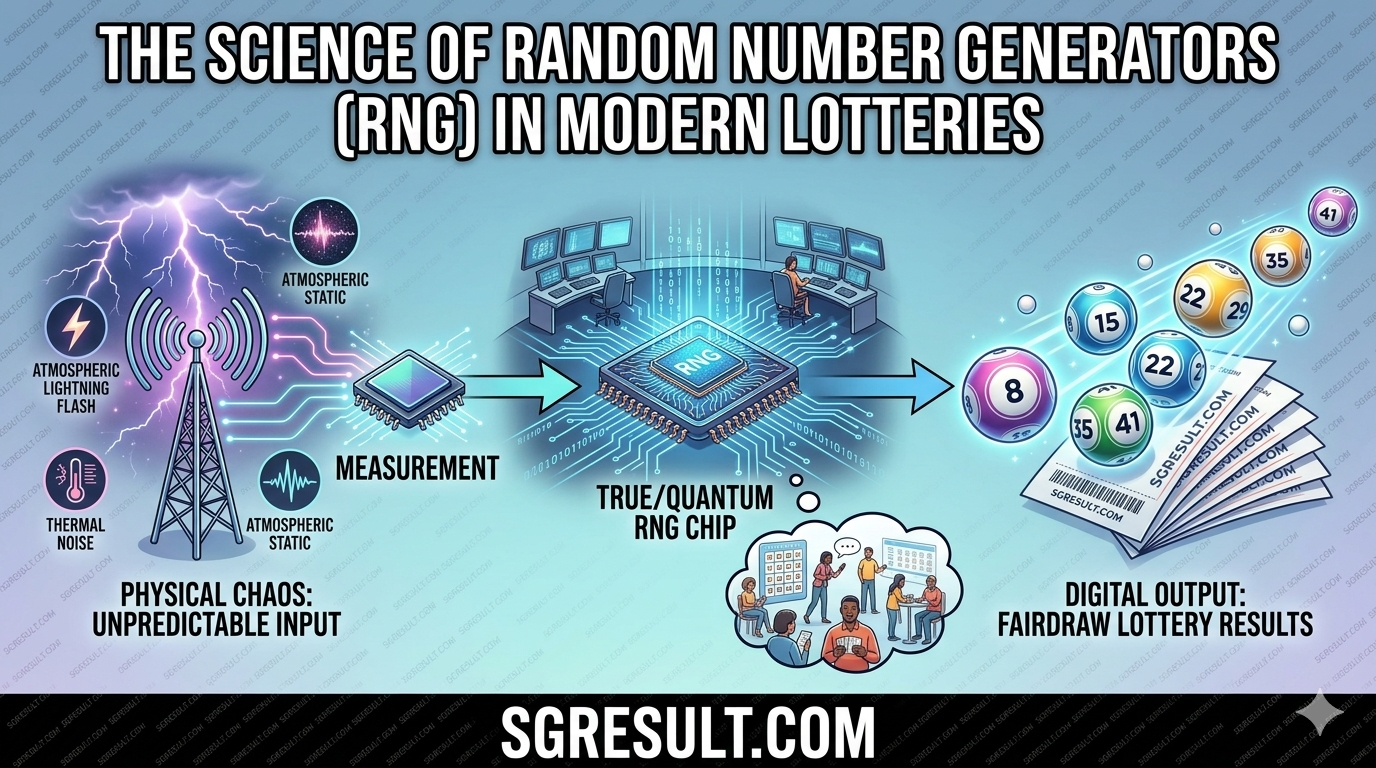
These high-tech machines use sensors to measure microscopic, unpredictable environmental factors. Common physical phenomena used in lottery RNGs include:
Thermal Noise: The microscopic, random movements of electrons within a conductor.
Atmospheric Noise: Static generated by lightning strikes happening globally.
Radioactive Decay: The completely unpredictable rate at which certain harmless isotopes decay.
Photonic Activity: Firing a laser at a half-silvered mirror and measuring exactly which direction a single photon bounces.
The RNG takes these chaotic, unpredictable physical measurements and translates them into a sequence of numbers. Because the physical universe is fundamentally unpredictable at a quantum level, the numbers generated are completely impossible to predict or hack.
Strict Auditing and Certification
Even with the most advanced quantum technology, skepticism is natural when money is involved. To ensure the public's trust, lottery operators do not just build an RNG and use it blindly.
Before a machine is ever used to draw a 4D or TOTO number, it undergoes rigorous testing by independent, third-party cybersecurity and gaming laboratories (such as GLI or eCOGRA). These organizations run massive statistical tests, analyzing millions of generated numbers to ensure there are no hidden patterns, biases, or predictive sequences.
Furthermore, the physical RNG machines are kept in highly secured, climate-controlled vaults with 24/7 surveillance, and multiple people are required to unlock them.
The Blend of Tradition and Technology
While many lotteries are shifting to pure RNG systems for speed and security, some still use physical mechanical draws (the spinning drums) to maintain the traditional "spectacle" for live television.
However, whether the numbers are drawn by a spinning drum or a quantum RNG machine, the mathematical probability of your ticket winning remains exactly the same. You can verify the outcome of these secure draws by checking the latest results on our homepage.
Conclusion
The next time you check your numbers against the 4D results history or past TOTO results, you can rest assured knowing that the numbers were not chosen by a rigged computer program. They are the result of highly secure, audited machines that literally harness the unpredictable chaos of the physical universe to ensure a 100% fair game.
Remember, because the system is truly random, no system or "lucky" pattern can predict the next draw. Always play responsibly and for entertainment only!