

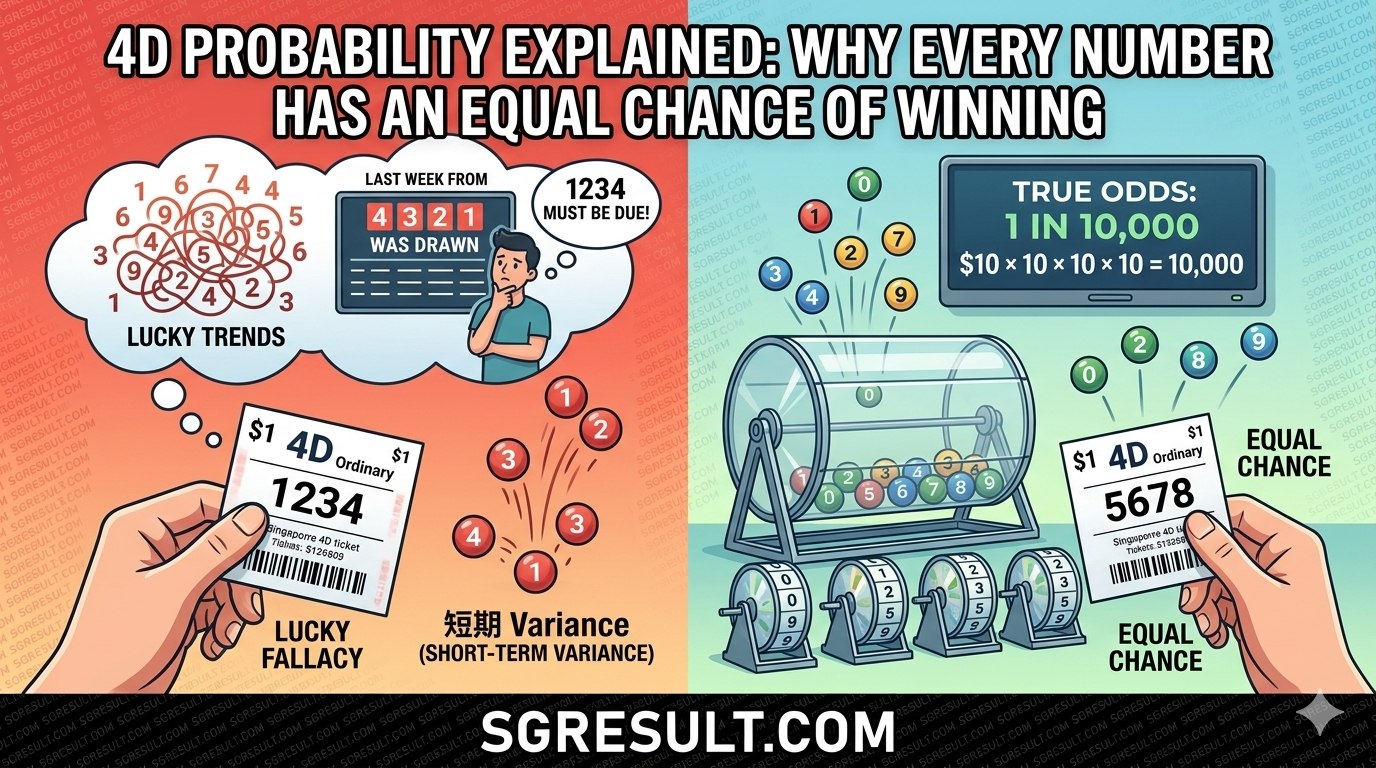
4D Probability Explained: Why Every Number Has an Equal Chance of Winning
If you talk to any regular Singapore 4D player, you will likely hear strategies involving "lucky" numbers, "hot" numbers that have been drawn recently, or "cold" numbers that are supposedly "due" for a win. It is human nature to look for patterns in chaos.
However, from a purely mathematical standpoint, the lottery does not care about patterns, past results, or personal superstitions. Let’s break down the actual probability of Singapore 4D and explain why every single number—from 0000 to 9999—has the exact same chance of winning in every single draw.
The Basic Math: 1 in 10,000
The math behind 4D is incredibly straightforward. The game uses a set of four digits, with each digit ranging from 0 to 9.
If you calculate the total number of possible combinations (10 x 10 x 10 x 10), you get exactly 10,000 unique numbers (ranging from 0000 to 9999).
In every draw, 23 winning numbers are selected across different prize categories (1st, 2nd, 3rd, Starter, and Consolation).
The probability of your specific 4-digit number winning the 1st Prize is exactly 1 in 10,000 (or 0.01%).
The overall probability of your number winning any of the 23 prizes is 23 in 10,000 (or 0.23%).
These odds are fixed. They never change, regardless of what happened in yesterday's draw or last year's draws.
The Concept of "Independent Events"
The most important concept to understand in 4D probability is the "Independent Event."
In statistics, an independent event means that the outcome of one event does not affect the outcome of another. The lottery machines used by Singapore Pools have no memory. When the machine randomly selects the winning digits for tonight's draw, it does not "remember" that the number "8888" was drawn last week, nor does it know that "1234" hasn't appeared in two years.
Because the machine resets completely for every single draw, the number "8888" has the exact same 1 in 10,000 chance of being drawn tonight as the number "1234", or any other combination.
Debunking the "Hot" and "Cold" Number Myth
If every number has an equal chance, why do we see some numbers drawn more frequently than others in a given year? This is a phenomenon called Variance.
In the short term, random distribution always looks clumpy. If you flip a coin 10 times, you might get 7 heads and 3 tails. That doesn't mean heads is "hot"; it's just short-term variance. However, if you flip that coin 100,000 times, the results will settle right around 50/50.
The same applies to 4D. If you look at our 4D statistics page, you will notice certain numbers have appeared more often in recent months. This is natural statistical variance, not a predictor of future draws. Over an infinite number of draws, every single four-digit combination will eventually be drawn the exact same number of times.
So, Why Do People Still Track Trends?
Even though mathematics dictates that every draw is entirely random, tracking trends is a huge part of the fun for many players!
Analyzing historical data allows players to feel more engaged with the game. Whether you like to bet on numbers that haven't appeared in a while, or you prefer riding the wave of recently drawn digits, checking the 4D results history adds an extra layer of entertainment to the experience.
Conclusion
Understanding 4D probability frees you from the stress of finding the "perfect" system. Whether you buy a carefully analyzed ticket or a random Quick Pick, your odds of hitting the jackpot remain exactly 1 in 10,000.
Always treat 4D as a fun game of chance. Set a strict budget, enjoy the excitement of checking the live draws on our homepage, and always play responsibly!